On 1 September 2026, Delhi Chief Minister Rekha Gupta, alongside
Power Minister Ashish Sood, announced a revised Delhi Solar Policy at
a press conference. It changes the arithmetic of rooftop solar in the capital completely, because for a
large share of Delhi households the cost of a solar system is now zero.
This guide covers the exact subsidy breakdown, who qualifies, how to apply, and the mistakes that
cost people their subsidy.
The headline in one place
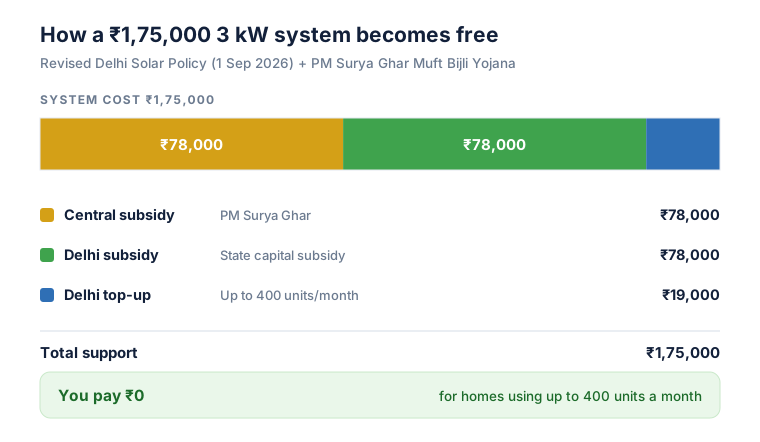
The Delhi Government's state subsidy is now up to ₹78,000 on a 3 kW system.
The central PM Surya Ghar subsidy of ₹78,000 comes on top of it.
Homes using up to 400 units a month also get a ₹19,000 top-up
— which brings your share of a 3 kW system to ₹0.
Delhi's target: rooftop solar on 2.3 lakh households by March 2027.
Three subsidies stack up to exactly the listed system cost. Figures: revised Delhi Solar Policy, 1 September 2026.
1. What changed in the Delhi Solar Policy
The earlier Delhi Solar Energy Policy 2023 (notified on 14 March 2024) already had a
capital subsidy and a Generation Based Incentive, but the amounts were nowhere near enough to cover a
whole system. The 2026 revision changes three things:
A much larger state subsidy — up to ₹78,000 on a 3 kW residential rooftop system.
A new top-up — ₹19,000 (3 kW) or ₹18,000 (2 kW) for households consuming up to
400 units a month.
Separate support for societies — a structured subsidy for group housing society
common-area installations.
At the press conference the Chief Minister said the government wants not only to reduce electricity
bills but to support the installation cost itself, and that free rooftop solar would be provided
to every household consuming up to 400 units.
solar.delhi.gov.in
The Delhi Solar Portal is where the state subsidy and Generation Based Incentive applications are filed. Source: solar.delhi.gov.in, Department of Power, Government of NCT of Delhi.
2. The slab-wise subsidy table
These are the Delhi Government's published numbers. Find the row that matches your monthly usage:
Monthly usage
System
Cost
Central
Delhi
Top-up
You pay
Est. monthly benefit
0–200 units
2 kW
₹1,30,000
₹60,000
₹52,000
₹18,000
₹0
~₹300
0–200 units
3 kW
₹1,75,000
₹78,000
₹78,000
₹19,000
₹0
~₹950
201–400 units
2 kW
₹1,30,000
₹60,000
₹52,000
₹18,000
₹0
~₹1,659
201–400 units
3 kW
₹1,75,000
₹78,000
₹78,000
₹19,000
₹0
~₹1,659
Over 400 units
3 kW
₹1,75,000
₹78,000
₹78,000
—
₹19,000
~₹2,143
In the 400-plus category, surplus electricity can be sold to the grid at
₹6.50 per unit — which is why the monthly benefit is highest in that slab.
3. Why 400 units is the number that matters
The entire policy pivots on one figure: 400 units a month.
400 units or below: you get the ₹19,000 (3 kW) or ₹18,000 (2 kW) Delhi top-up.
Central plus Delhi plus top-up equals the full listed cost, so nothing comes out of your pocket.
Above 400 units: no top-up. On a 3 kW system your contribution is ₹19,000 — still
only about 11% of a ₹1.75 lakh system.
Here is the counter-intuitive part: heavier users benefit more each month
(about ₹2,143 versus about ₹950), because their tariff slab is higher and exported surplus is counted at
₹6.50 a unit. That ₹19,000 contribution is typically recovered in roughly nine months.
Common areas in Delhi societies — lifts, water pumps, corridor lighting, STPs — consume a great deal
of electricity. The revised policy has a separate structure for them:
System
Estimated cost
Central subsidy
Delhi subsidy
Society contribution
Est. monthly benefit
100 kW
₹45,00,000
₹18,00,000
₹11,00,000
₹16,00,000
~₹81,247
A ₹16 lakh investment returning roughly ₹81,000 a month works out to a payback of about
20 months, and it shows up directly in the society's maintenance charges.
5. Who is eligible
A valid domestic electricity connection in Delhi (BRPL, BYPL or TPDDL).
The connection must be in your name — the subsidy is credited to that person's
bank account by DBT.
A shadow-free roof: roughly 180 sq ft for 2 kW, 270–300 sq ft for 3 kW.
Ownership of the roof, or written NOC (essential for builder floors and societies).
A net meter — the Delhi subsidy and GBI apply only to net metered installations.
6. How to apply
Register on the PM Surya Ghar portal with your consumer number and discom details.
Select a vendor and obtain feasibility approval.
Get the system installed.
Apply to your discom for the net meter; it is fitted after inspection.
Apply for the Delhi subsidy and GBI on the Delhi Solar Portal.
After verification both subsidies arrive by DBT in your bank account.
Worth repeating: choosing a vendor empanelled on the PM Surya Ghar portal is
not mandatory for the Delhi subsidy. The Delhi Solar Portal states that customers may
choose any vendor they like.
Read the official rule →
7. How long it takes
A realistic timeline, based on SolarfiX projects in Delhi:
Survey to quotation: 1–2 days
Registration and feasibility approval: 5–10 days
Installation: 1–3 days
Net meter inspection and fitting: 10–20 days
Subsidy credited after the net meter: usually 30–45 days
So roughly 25 to 45 days from the first call to money in the account, assuming your
documents are complete.
8. Mistakes that hold up your subsidy
Installing before registering. Always register on the portal first, or the claim
can be rejected.
Connection in somebody else's name. The subsidy goes to the connection holder, so
the names must match.
Skipping the net meter. Without it there is no Delhi subsidy and no GBI.
Panels outside approved specifications. Subsidy requires modules that meet the
approved specs.
Bank KYC mismatch. DBT simply fails — check the account details carefully.
What to do next
Pull out your last electricity bill and note the units consumed.
Book a free survey to confirm how much shadow-free area your roof actually has.
Sources:
Revised Delhi Solar Policy announcement, 1 September 2026 — Chief Minister Rekha Gupta and Power
Minister Ashish Sood (Hindustan Times report);
Delhi Solar Portal
(Delhi Solar Energy Policy 2023, notified 14 March 2024);
PM Surya Ghar Muft Bijli Yojana.
All figures are the Delhi Government's own published estimates and may change when the policy is revised.
Delhi free solar panel scheme 2026: homes using up to 400 units a month get a 3 kW rooftop system fully covered by subsidy. Eligibility, the catch, and how to apply.
The official Delhi Solar Portal rule: choosing a PM Surya Ghar empanelled vendor is not mandatory. Delhi subsidy and GBI apply to all net meter installations.
3 kW solar panel price in Delhi 2026: ₹1.75 lakh listed cost, ₹0 to ₹19,000 after subsidy. Monthly generation, savings by slab and a 25-year calculation.
How to apply for solar subsidy in Delhi: PM Surya Ghar registration, Delhi Solar Portal application, document checklist, net metering and realistic timelines.
Read the guide →
Want your exact numbers?
Keep your electricity bill handy and call us — in five minutes we'll tell you your subsidy, what you'd pay and what you'd save.