
Policy update
Delhi Solar Subsidy 2026: the complete ₹78,000 guide
A slab-by-slab breakdown of the revised policy announced on 1 September 2026 — how much you get, who qualifies, and how to apply.
Read the guide →
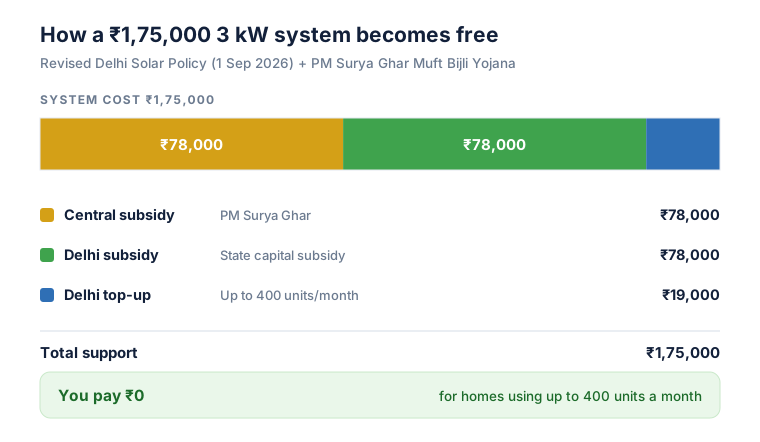
The Delhi Government's new subsidy of ₹78,000 plus the central PM Surya Ghar subsidy of ₹78,000 and a ₹19,000 top-up together cover the entire ₹1.75 lakh cost. You pay ₹0 — and your electricity bill all but disappears.
 Registered as Electrik Bee Private Limited — genuine
modules, official warranty
Registered as Electrik Bee Private Limited — genuine
modules, official warranty
For Delhi addresses. Our team calls you back within 30 minutes.
A 3 kW system, ₹1.75 lakh of subsidy, net metering, and how the bill gets down to almost nothing — explained by the SolarfiX team.
Pick whichever one you came here for. Each answer is written for Delhi specifically — Delhi's subsidy, Delhi's discoms, Delhi's rooftops.
The slab-wise table with the Delhi Government's own numbers for 2 kW and 3 kW systems.
It comes down to one number on your electricity bill. Here's how to check it in a minute.
The ₹1.75 lakh listed price, what's inside it, and what you pay after subsidy.
Only one of the three is net metered — and net metering is what the subsidy needs.
Two portals, one document checklist, and the sequence that keeps your claim from stalling.
No — and the Delhi Solar Portal says so itself. Here's the official wording.
Chief Minister Rekha Gupta announced the revised Delhi Solar Policy on 1 September 2026. The figures below are the Delhi Government's own published numbers.
| Monthly usage | System | System cost | Central (PM Surya Ghar) | Delhi subsidy | Delhi top-up | You pay | Est. monthly benefit |
|---|---|---|---|---|---|---|---|
| 0 – 200 units | 2 kW | ₹1,30,000 | ₹60,000 | ₹52,000 | ₹18,000 | ₹0 · FREE | ~₹300 |
| 0 – 200 units | 3 kW | ₹1,75,000 | ₹78,000 | ₹78,000 | ₹19,000 | ₹0 · FREE | ~₹950 |
| 201 – 400 units | 2 kW | ₹1,30,000 | ₹60,000 | ₹52,000 | ₹18,000 | ₹0 · FREE | ~₹1,659 |
| 201 – 400 units | 3 kW | ₹1,75,000 | ₹78,000 | ₹78,000 | ₹19,000 | ₹0 · FREE | ~₹1,659 |
| Over 400 units | 3 kW | ₹1,75,000 | ₹78,000 | ₹78,000 | — | ₹19,000 | ~₹2,143 |
| Group housing society (common area) | 100 kW | ₹45,00,000 | ₹18,00,000 | ₹11,00,000 | — | ₹16,00,000 | ~₹81,247 |
Source: revised Delhi Solar Policy, announced at a Delhi Government press conference on 1 September 2026 by Chief Minister Rekha Gupta and Power Minister Ashish Sood, together with the PM Surya Ghar Muft Bijli Yojana. In the 400-plus category, surplus electricity can be sold to the grid at ₹6.50 per unit. These are government estimates — your final numbers depend on your roof, your discom and your actual consumption. The Delhi Government's target is rooftop solar on 2.3 lakh households by March 2027.
The central subsidy, Delhi subsidy and top-up together cover the full listed cost of both 2 kW and 3 kW systems. Nothing to pay upfront.
Net metering sends your extra units to the grid. In the 400-plus category, exports are counted at ₹6.50 per unit — so the meter runs in your favour.
Alongside the capital subsidy, the Delhi Solar Policy also offers a Generation Based Incentive on all net metered installations, by category.
Enter your monthly consumption to see your subsidy, what you would actually pay, and what you save over 25 years.
Your bill shows this as “Units Consumed”. Can't find it? Divide the bill amount by roughly ₹7 for a rough estimate.
Large home, 5 kW–10 kW, or a society installation? Book a free survey — our team will give you exact numbers after seeing the roof.
The calculator uses the Delhi Government's published subsidy structure and average benefit estimates. It is an estimate, not a final quotation.
This is the first real decision, and it decides whether you get the subsidy at all.
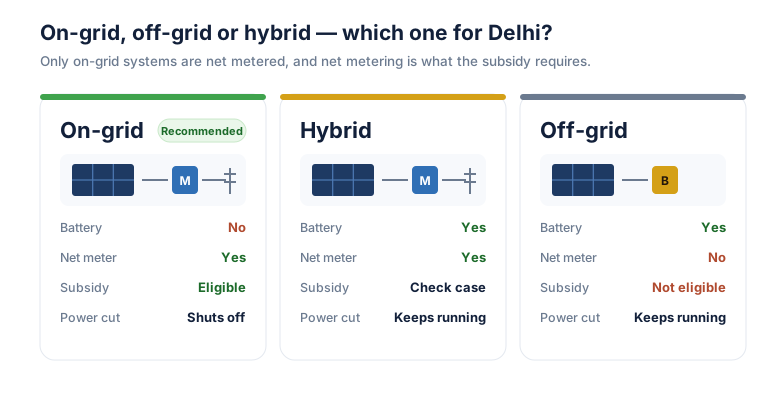
No battery, so it costs less and qualifies for both subsidies. It exports surplus units to the grid through the net meter. It does shut down during a power cut, by design, for lineman safety.
Adds a battery so essential loads keep running when the grid is down. Costs more, and the subsidy position depends on how the system is configured — we check it case by case.
No grid connection and no net meter, so no Delhi subsidy and no GBI. It makes sense only where there is no reliable supply at all, which is not most of Delhi.
Most quotations quietly assume the cheapest frame. In Delhi, where terraces are used for water tanks, drying clothes and gatherings, that is often the wrong trade.
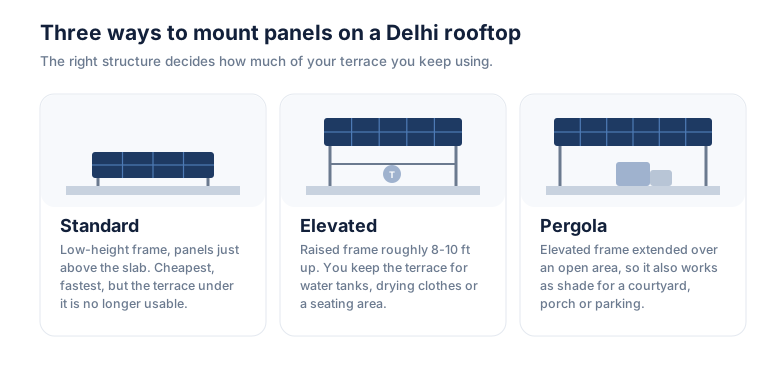
Lowest cost and quickest to install. Best where the terrace is not used for anything else.
Roughly 8–10 ft of clearance. Water tanks, washing lines and seating all still work, and the shade underneath makes the terrace usable in summer.
Extends over a courtyard, porch or parking bay, so the same panels also shade a car or an entrance. Needs a structural check first.
Elevated and pergola structures cost more than the listed standard system. We quote them separately and in writing, so you can see exactly what the difference buys.
Many people assume the subsidy only comes through vendors listed on the portal. The Delhi Solar Portal itself says otherwise:
“Consumers other than PM Surya Ghar–Muft Bijli Yojna: In this category, it is not mandatory to choose a vendor empanelled with PM Surya Ghar Portal. Customers can choose any vendor of their choice. Delhi subsidy and Generation Based Incentive are available for all net meter installations under respective categories, customers have full liberty to make choices of vendors. The list of empanelled vendors above is only for reference purpose.”
For the Delhi subsidy and GBI you have full liberty to pick your installer. Judge them on quality, warranty and service.
With proper net metering and documentation, the Delhi subsidy and GBI apply to installations in the respective categories.
SolarfiX Infra files both the PM Surya Ghar process and the Delhi Solar Portal process on your behalf.
Fitting panels is the easy part. Subsidy, net metering and 25 years of service are what actually matter.
SolarfiX Infra is the retail brand of Electrik Bee Private Limited, the entity registered with Reliance New Energy. Genuine modules, official warranty and a brand-backed supply chain — not unbranded panels of unknown origin.
PM Surya Ghar registration, the Delhi Solar Portal application, GBI and the net meter file — end to end, at no extra charge.
BRPL, BYPL and TPDDL processes, inspections and society NOCs — Delhi is our entire focus.
Mounting structure, DC/AC cabling, earthing, lightning arrestor and a cleaning or AMC plan — from one team.
1 kW to 10 kW residential, group housing society common-area solar, and commercial and industrial systems.
Panel make, inverter model, structure specification and subsidy amount — all in writing. No hidden charges.
Based on the Delhi Government's announcement of 1 September 2026. Only around 10,000 buildings in Delhi currently have rooftop solar, and most of those are government buildings — which is why approvals are still quick.
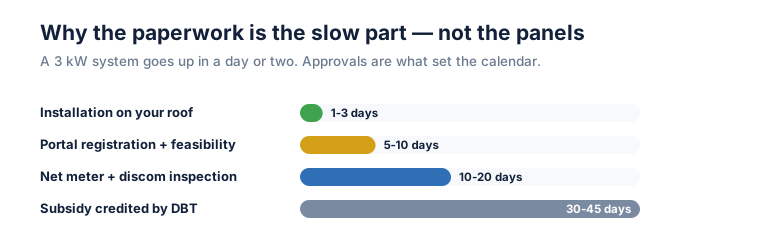
From the first call to the subsidy landing in your account — typically 25 to 45 days.
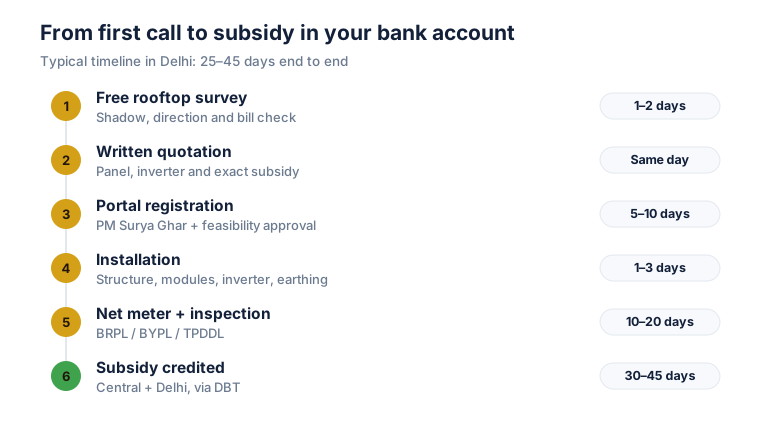
Our team checks your roof, shadow, orientation and electricity bill to work out the right system size.
Panel make, inverter, structure and the exact subsidy for your consumption slab — all in writing.
PM Surya Ghar portal registration, the Delhi Solar Portal subsidy and GBI application, and the discom net meter file.
Mounting structure, modules, inverter, cabling, earthing and safety devices — a trained team, one to three days.
BRPL, BYPL or TPDDL inspection, net meter installation and the commissioning report.
Central and Delhi subsidies arrive by DBT. After that, AMC and monitoring support.
For independent houses and builder floors. 2 kW and 3 kW are the most popular with the subsidy; 5 kW to 10 kW for larger homes.
For lifts, pumps and common-area lighting. A 100 kW system gets ₹18 lakh central and ₹11 lakh Delhi subsidy, with an estimated ₹81,247 monthly benefit.
Shops, offices, schools, factories and warehouses. Group Net Metering, RESCO and Hybrid RESCO models are also available.
The Delhi Solar Policy 2023 offers Group Net Metering and Community Solar for consumers with limited roof space.
Delhi's dust and pollution cut generation. Regular cleaning plus preventive maintenance plans.
Already have solar but generation is low? We audit the inverter, strings and net meter readings.
If a quotation leaves any of these out, it isn’t cheaper — it’s incomplete. Ask for each line by name.
The subsidy is credited after the net meter is installed, so the order of payments matters. We put all of this in the written quotation.
3 kW system, ₹1,75,000 listed
3 kW system, ₹1,75,000 listed
Larger systems and societies
Subsidy amounts are the Delhi Government’s published figures for the listed system cost. Site-specific work — an elevated structure, long cable runs, roof waterproofing — is quoted separately after the survey, never added quietly later.
There are three ways to put solar on a roof in Delhi. The right one depends on whether you want the asset, or only the cheaper electricity.
You pay for the system and it is yours. Every unit it generates is yours, the savings are yours, and so is the asset for the next 25 years.
A developer installs the plant at their own cost on your roof. You pay nothing upfront and buy the electricity it generates at an agreed rate, usually below your discom tariff, under a long-term power purchase agreement.
A RESCO finances, installs, owns, operates and maintains the plant for the whole term. You simply consume the power and pay for it. The Delhi Solar Energy Policy 2023 lists RESCO and Hybrid RESCO as available models for consumers.
The bodies we are registered with and the brands we build with — the things you can check for yourself before you hand anyone your roof.












The relationships that actually affect your installation — who supplies the modules, and who has to approve the meter.
Reliance New Energy
Authorised Channel Partner — modules and warranty
Your net meter is sanctioned by whichever of the three discoms serves your address — we file, follow up and attend the inspection. Subsidy claims go to the PM Surya Ghar and Delhi Solar portals.
We work only in Delhi — which is why we know every zone's discom process, society rules and inspection timelines.
Don't see your area? Call +91 96546 54369 — we cover all Delhi pincodes.
Policy, cost and process — explained in plain language, with official sources.
A slab-by-slab breakdown of the revised policy announced on 1 September 2026 — how much you get, who qualifies, and how to apply.
How the ₹19,000 top-up works, how to check your eligibility in a minute, and what changes once you cross 400 units.
The official rule on the Delhi Solar Portal, which category it applies to, and the eight things to check when choosing a vendor.
The ₹1.75 lakh listed cost, the net price after subsidy, monthly generation, and a realistic 25-year savings calculation.
Registration on both portals, the document checklist, the net meter application, and how long the subsidy actually takes.
Keep your electricity bill handy and call us — in five minutes we’ll tell you your exact subsidy and the right system size.
Under the revised Delhi Solar Policy announced on 1 September 2026, a 3 kW rooftop system gets ₹78,000 from the Delhi Government and ₹78,000 from the central PM Surya Ghar scheme. Homes using up to 400 units a month also get an extra ₹19,000 Delhi top-up, which covers the entire ₹1,75,000 cost of the system. A 2 kW system gets ₹60,000 central, ₹52,000 Delhi and an ₹18,000 top-up.
Yes. According to the Delhi Government, households consuming 400 units a month or less have their 3 kW rooftop system fully funded — the central subsidy (₹78,000), Delhi subsidy (₹78,000) and ₹19,000 top-up together match the system's listed cost, so the homeowner pays ₹0. Households above 400 units do not get the ₹19,000 top-up, so their contribution is ₹19,000.
No. The Delhi Solar Portal states that for categories other than PM Surya Ghar–Muft Bijli Yojana it is not mandatory to choose a vendor empanelled with the PM Surya Ghar Portal. Customers can choose any vendor of their choice, and the Delhi subsidy and Generation Based Incentive are available for all net meter installations under the respective categories. The empanelled list on the portal is for reference only.
The Delhi Government's revised policy documents list a 3 kW rooftop system at about ₹1,75,000. After subsidy the net cost falls to ₹0 for homes using up to 400 units a month, and to about ₹19,000 for homes consuming more than 400 units.
The Delhi Government estimates an average additional monthly benefit of about ₹1,659 in the 201–400 unit category and about ₹2,143 in the 400-plus category, which includes selling surplus electricity to the grid at ₹6.50 per unit. A 3 kW system is estimated to save around 200 units and export another 100 units a month.
As a rule of thumb, 1 kW needs about 80–100 sq ft of shadow-free roof. So 2 kW needs roughly 180 sq ft and 3 kW about 270–300 sq ft. If your roof is smaller, the Delhi Solar Policy 2023 offers Group Net Metering and Community Solar models.
After installation and net meter commissioning, you apply for the Delhi subsidy and GBI on the Delhi Solar Portal, while the central subsidy is claimed through the PM Surya Ghar portal. Both are transferred directly to your bank account by DBT. SolarfiX Infra handles this paperwork for you.
Your area's distribution company — BSES Rajdhani (BRPL), BSES Yamuna (BYPL) or Tata Power Delhi Distribution (TPDDL). SolarfiX Infra files the net meter application, follows up on feasibility approval and coordinates the inspection on your behalf.
Solar modules typically carry a 25–30 year performance warranty and a 10–12 year product warranty; inverters carry 5–10 years. Electrik Bee Private Limited, trading as SolarfiX Infra, is an Authorised Channel Partner of Reliance New Energy, so modules and warranty claims are processed through the official channel.
Yes. The revised Delhi policy provides separate support for group housing societies. A 100 kW system estimated at ₹45 lakh receives ₹18 lakh central subsidy and ₹11 lakh Delhi subsidy, leaving a ₹16 lakh society contribution, with an estimated average monthly benefit of ₹81,247.
A standard on-grid (net metered) system shuts down during a grid failure for safety — it has no battery, which is what keeps the cost low and the subsidy applicable. If you need backup, a hybrid system with a battery is an option; we compare both during the survey.
The electricity connection and roof rights matter, because the subsidy is paid to the connection holder. With the landlord's written permission it can be done. We confirm the exact requirement during the site survey.
The Delhi Government's target is 2.3 lakh households by March 2027 — early applicants get approvals and installation slots faster. Book a free survey today.